Cold therapy for chemo neuropathy means cooling the hands and feet during certain chemotherapy infusions. The goal is to reduce how much of the drug reaches the small nerves in your fingers and toes. Cancer centers use it alongside taxanes like paclitaxel (Taxol) and docetaxel, and studies suggest it may help reduce the risk of chemotherapy-induced peripheral neuropathy (CIPN).
This guide explains what CIPN is, how CIPN cryotherapy works, what the research shows, and how to use cold therapy during an infusion. Always talk with your oncology team before you start.
What is chemotherapy-induced peripheral neuropathy?
CIPN is nerve damage caused by some chemotherapy drugs. It usually starts in the fingertips and toes and can move up the hands and feet. Common symptoms include:
Numbness, tingling or "pins and needles"
Burning, shooting or electric-shock pain
Trouble with buttons, writing or picking up small objects
Poor balance or trouble feeling the floor when walking
Sensitivity to cold or touch
The drugs most linked to CIPN are taxanes (paclitaxel, docetaxel, nab-paclitaxel) and platinum drugs, especially oxaliplatin. Vinca alkaloids, bortezomib and some others can also cause it. Up to 81% of patients treated with paclitaxel report CIPN symptoms, and for some people they last for years after treatment ends. [9]
Why CIPN matters during treatment
CIPN is not just uncomfortable. When symptoms get worse, oncologists may delay a dose, lower it or stop the drug early. That can affect the treatment plan itself. There is no drug proven to reduce the risk of CIPN, which is why many patients and care teams look at non-drug options like cold therapy and compression.
Check It Out
How cold therapy works during chemo
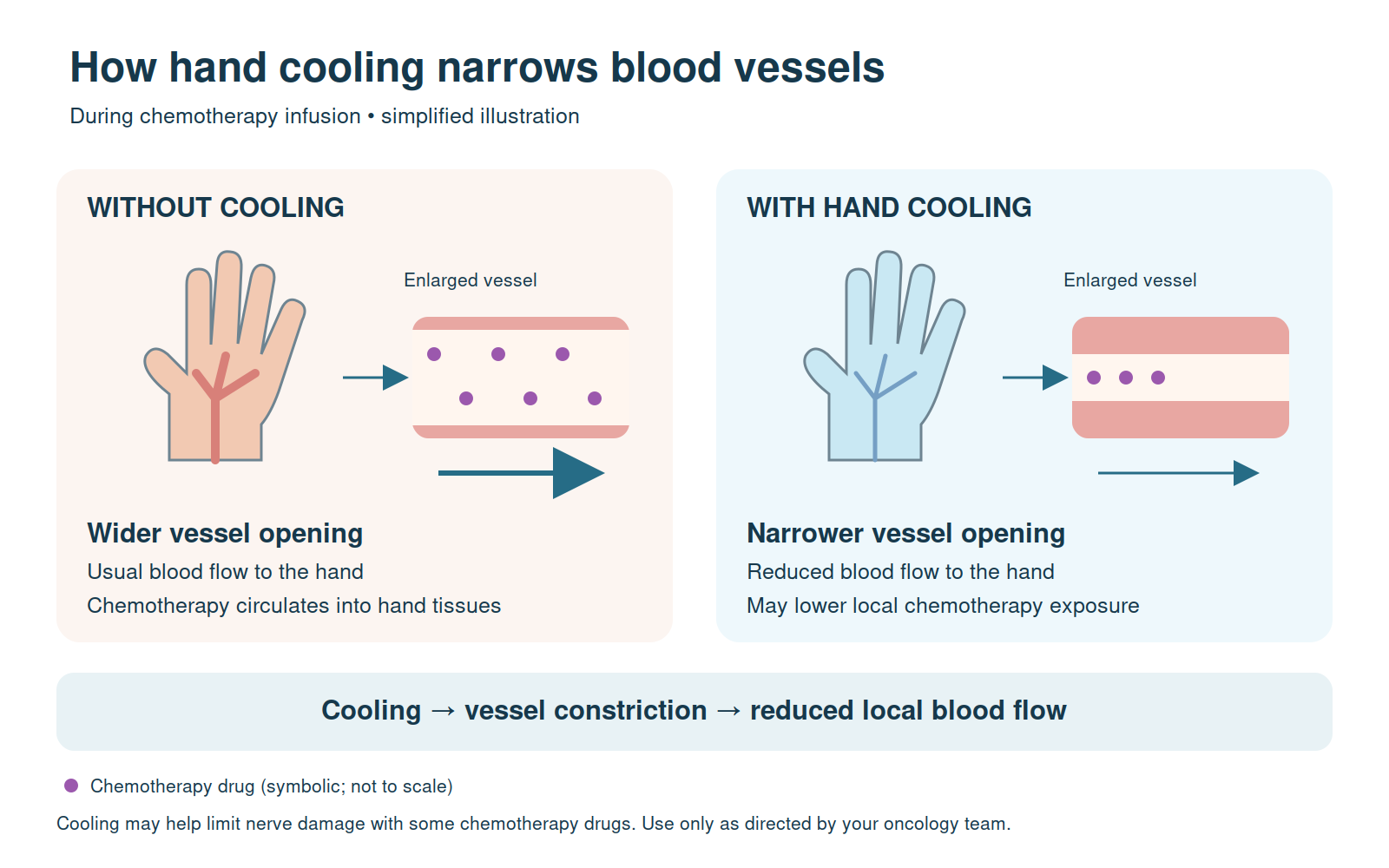
Cold therapy works by narrowing the blood vessels in the hands and feet while the drug is in your bloodstream. Less blood flow to those areas may mean less of the drug reaches the nerves there.
Frozen wraps, gloves or socks cool the skin of the hands and feet.
The cold makes small blood vessels tighten (vasoconstriction).
Less blood flows to the fingers and toes during the infusion.
Less of the chemo drug may reach the nerve endings there.
Cooling ends shortly after the infusion, and normal blood flow returns.
Compression works in a similar way. Snug pressure on the hands and feet also reduces blood flow to the small vessels near the skin. That is why several newer studies combine cooling with compression, often called cryocompression.
Timing matters. Cooling has to be in place while the drug levels in your blood are highest. That is why study protocols start before the infusion and continue until after it ends.
What the research shows about CIPN cryotherapy
The evidence for cold therapy is promising but not settled. Several reviews have found fewer cases of CIPN with cooling, while the overall certainty of evidence is still rated low. Here is a balanced summary.
Cryotherapy ranked as the most effective non-drug option in a 2025 review
A 2025 network meta-analysis pooled 13 studies with 865 patients receiving neurotoxic chemotherapy. Cooling the hands and feet was linked to lower odds of CIPN than usual care (odds ratio 0.32). Compression came next (odds ratio 0.44). Among specific methods, continuous cooling and frozen gloves ranked highest. The authors rated the certainty of this evidence as low because of study differences and risk of bias. [1]
A separate 2025 meta-analysis of 14 studies in breast cancer patients on paclitaxel or nab-paclitaxel found cryotherapy was linked to 55% fewer cases of grade 2 or higher neuropathy. [2]
Notes they may help, but makes no recommendation for use outside clinical trials because of limited studies. [3][4]
European Society for Medical Oncology
Says cryotherapy and compression can be considered as ways that may help reduce the risk of CIPN. [4]
In short, cold therapy is not yet a standard of care in the U.S. Your oncology team decides whether it fits your treatment plan.
Why compression is part of the conversation
Compression narrows small blood vessels in a similar way to cold. Meta-analyses of compression alone have found lower CIPN rates, mostly in patients on paclitaxel. [5] In a 2025 randomized trial of 122 women with breast cancer, both hand cooling and hand compression lowered rates of grade 2 or higher sensory neuropathy compared with the untreated hand. [6]
Several current trials pair the two, often called cryocompression. [7][8] Every SMI Chemo Infusion Cooling Wrap combines cold with adjustable compression straps that keep the cold in steady contact with the skin.
Comfort affects whether patients finish the protocol
Cooling only helps if patients can keep it on. In one 2024 randomized trial, only 35% of patients stuck with frozen gloves and socks, compared with 73% for compression garments. [9] Discomfort from very cold, rigid gloves was a common problem. This is one reason the type of cooling product matters.
Cancer centers are building programs
In May 2026, the Nassif Community Cancer Center in Cedar Rapids, Iowa reported a 25-patient pilot of frozen gloves and socks during paclitaxel. Researchers said neuropathy rates stayed below national averages for paclitaxel, and the center now offers cryotherapy as an optional supportive service. [10] It was a small study without a control group, but it shows how infusion centers are putting cooling into practice.
How long to ice hands and feet during Taxol and other infusions
Most studies cool the hands and feet from 15 minutes before the infusion starts until 15 minutes after it ends. This is the schedule used in several paclitaxel (Taxol) trials and in the 2026 Iowa pilot. [10][11] Always follow your care team's instructions, since your drug, dose and infusion time may call for a different plan.
The protocol most studies used
15 minutes before chemo: put cold wraps, gloves or socks on both hands and both feet.
During the infusion: keep them on the whole time, while the drug is running.
15 minutes after chemo ends: keep cooling, then remove.
Swap if the cold fades: replace with freshly frozen packs if the infusion runs longer than the product stays cold.
For a weekly one-hour paclitaxel infusion, that adds up to about 90 minutes of cooling. One well-known trial had patients wear frozen gloves and socks for 90 minutes, including the full infusion. [12] Longer regimens, such as paclitaxel with carboplatin, can run three hours or more.
Check It Out
Using the SMI Chemo Infusion Cooling Wrap
Freeze the 3+ hour gel bags flat before your appointment and bring them in a small cooler.
Slide two gel bags into each wrap so the cold covers both the top and the bottom of the hand or foot.
Snug the compression straps so the wrap sits flat against the skin without pinching.
Infusions of 3 hours or less: the 8-gel-bag kit covers both hands and both feet.
Infusions over 3 hours: the 16-gel-bag kit lets you swap all eight bags at about the 2.5-hour mark.
Tell your nurse right away if you feel burning, sharp pain or intense numbness while cooling, or if your skin looks white or blue. Cold sensitivity is the most common side effect reported in studies. [2]
The problem with typical frozen gloves for chemo
Frozen gloves and socks are the most common way patients try cold therapy, but many don't stay cold long enough. In patient communities, people often say their ice gloves for chemo warm up within 15 minutes to an hour, before a Taxol infusion is even done. [13] For a three-hour carboplatin and paclitaxel infusion, the gap is even bigger.
What patients and nurses commonly report:
The cold doesn't last. Many patients pack a second or third set in a cooler and swap halfway through. [13]
Too cold at first. Packs straight from the freezer can be painfully cold, so patients add cotton liners to protect their skin. [13]
Poor fit. Loose mitts and booties leave air gaps, so the cold doesn't reach the whole hand or foot.
Mess and condensation. Melting ice, frozen peas and sweating packs mean wet skin, wet chairs and cleanup for nursing staff.
Hard to stick with. Discomfort is a key reason patients stop. In one trial, only about a third stayed with frozen gloves and socks. [9]
How the SMI Chemo Infusion Cooling Wrap is different
The SMI Chemo Infusion Cooling Wrap was designed for the full length of an infusion, not just part of it.
Cools the top and the bottom of each hand and foot
Holds the cold flat against the skin, with no air gaps, adds compression, and temperature control
Keeps condensation off the skin and buffers direct contact with the gel, while preventing frostbite and skin damage.
No dripping, no wet chairs, less cleanup for staff
Quick to put on and remove; nurses can still reach the hand
One kit can be used across a full course of treatment
Frozen gloves vs. cooling wraps vs. machines: chemo cooling options compared
Each way to cool the hands and feet during chemo trades off cold duration, comfort, mess and cost. This table compares the four most common options.
Frozen gloves and mitts
Ice bags
Cooling machines
SMI Chemo Cooling Wrap
Cold duration
Often under 1 hour; swaps needed
Melts during infusion; refills needed
Continuous while plugged in
3+ hours per gel bag set
Compression
None
None
Some models
Adjustable straps on every wrap
Mess
Condensation, dripping
Melted ice, leaky bags
Hoses, leaky disconnects
No ice or water; moisture-wicking liner
Safety
Can be painfully cold on bare skin
Trip hazard, melted ice
Cords and hoses, trip hazard
No cords, hoses, leaks, or frostbite
Cost
Low per pair; replace often
Low supplies; high staff time
High unit and patient cost
Low per patient; reusable
Staff time
Frequent swaps
High: filling, changing, cleanup
Setup and monitoring
Low: apply once for most infusions
Patient mobility
Limited by fit
Limited
Tethered to the unit
Full; not tethered
For infusion centers, SMI also offers a free freezer program with no minimum order or contract.
Check It Out
Who shouldn't use cold therapy during chemo without checking first
Cold therapy is not safe for everyone. Talk with your oncologist before using it if you have any of the conditions below. Clinical trials of cryotherapy commonly exclude people with these conditions. [9][8]
Cold sensitivity or cold intolerance, including cold-triggered pain or acute cold sensitivity from oxaliplatin
Raynaud's phenomenon, where fingers or toes turn white or blue in the cold
Peripheral arterial disease or other poor circulation in the hands or feet
Existing peripheral neuropathy, such as from diabetes or earlier chemotherapy
Lymphedema in the arm or leg where the wrap would go
Open wounds, skin breakdown or frostbite history on the hands or feet
Get the SMI Chemo Infusion Cooling Wrap
For patients and caregivers
Bring 3+ hours of cold and compression to every infusion. Each kit includes 4 wraps (two hands, two feet) and reusable 3+ hour gel bags. Free 2nd-day shipping. Made in the USA.
Tip: bring this page or the CIPN Patient Flyer to your next appointment to talk it over with your care team.
For infusion centers and oncology practices
Standardize cryotherapy for CIPN across your chairs. SMI supplies freezers at no charge, with no minimum order and no contract, and works with all major GPOs. Ask about facility pricing and a ready-made limb cryotherapy protocol.
Cold therapy for chemo neuropathy: frequently asked questions
Does icing hands during chemo help reduce the risk of neuropathy?
Icing hands and feet during chemo may help reduce the risk of neuropathy, but it is not guaranteed. Reviews of clinical studies have found fewer CIPN cases with cooling, especially during taxane chemotherapy, though the certainty of evidence is still low. Ask your oncology team whether it fits your plan.
When should I wear frozen gloves during chemo?
Most studies start cooling 15 minutes before the chemo infusion, keep it on for the whole infusion, and continue for 15 minutes after it ends. Cooling matters most while the neurotoxic drug, such as paclitaxel, is running. Follow your care team's instructions for your specific regimen.
How long should I ice my hands and feet during Taxol?
For a typical one-hour weekly Taxol infusion, studies used about 90 minutes of cooling: 15 minutes before, 60 minutes during and 15 minutes after. Longer infusions need longer cooling, so use a product that stays cold for the full time or swap in fresh packs.
Can cold therapy reverse existing neuropathy?
No. Cold therapy during chemo has been studied as a way to reduce the risk of new neuropathy, not to treat neuropathy you already have. If you already have numbness or tingling, talk with your doctor about treatment options and whether cooling is still safe for you.
Who shouldn't use cold therapy during chemo?
People with cold intolerance, Raynaud's phenomenon, peripheral arterial disease, existing neuropathy or lymphedema should check with their doctor first. Clinical trials commonly exclude these groups.
Does insurance cover cold therapy for chemo?
Most insurance plans do not cover cold therapy products, and Medicare cannot be billed for them. Some patients ask their insurer about reimbursement. The SMI Chemo Infusion Cooling Wrap lists HCPCS code A9273 for patients who want to submit a claim.
How long does the SMI Chemo Infusion Cooling Wrap stay cold?
Each set of SMI 3+ hour gel bags provides more than three hours of cold. The 8-gel-bag kit covers infusions of three hours or less. For longer infusions, the 16-gel-bag kit lets you swap in a fresh frozen set at about 2.5 hours.
Is cryotherapy for CIPN recommended by oncology guidelines?
Guidelines differ. ESMO says cryotherapy and compression can be considered as ways that may help reduce the risk of CIPN. ASCO notes they may help but makes no formal recommendation outside clinical trials because of limited data.
This page is for general education only and is not medical advice. Cold therapy may not be right for everyone and is not a substitute for care from your oncology team. Talk with your doctor or nurse before using any cooling product during chemotherapy, and follow their instructions. SMI Cold Therapy products are not intended to diagnose, treat, cure or prevent any disease unless stated in their FDA listing.
The Cold Standard in cold therapy.
MA DE IN THE USA
We use cookies to ensure that we give you the best experience on our website. If you continue to use this site we will assume that you are happy with it.