Most people use the words “ice pack” and “cold therapy” as if they describe the same thing, and for a minor bruise, the difference barely registers. After surgery or a serious injury, though, the distance between a freezer bag and a true cold therapy system turns out to matter quite a bit.
The two methods share a goal but go about it in very different ways. Knowing how they diverge, what each one handles well, and where one clearly beats the other makes it far easier to pick the option that actually fits your recovery.
Both approaches chase the same result. Lower the temperature of an injured area to ease pain, calm inflammation, and slow the swelling that follows trauma or surgery. The cold itself does real work, narrowing blood vessels and quieting the nerve signals that carry pain.
Where they part ways is in how they deliver that cold, how long they hold it, and what else they bring along with it.
A basic ice pack is cheap, easy to grab, and fine for short-term relief. Most households have one in the freezer. For a bumped knee or a sore shoulder after yard work, it gets the job done.
The trouble shows up the moment you need more than a few minutes of help. Its limits are practical.
For a quick ache, none of that is a dealbreaker. For post-surgery recovery that runs days or weeks, it adds up to a lot of melting, mopping, and sitting still.
Cold therapy treatment covers the more advanced end of the spectrum. Gel-bag systems, cold therapy machines, and cold compression therapy wraps are all designed to address the limitations of a plain ice pack.
The better systems hold their temperature for hours instead of minutes. Many add compression, which drives the cold deeper and limits the space where fluid can pool, speeding swelling reduction. And the well-designed ones let you move while you wear them, so recovery does not mean staying glued to the couch.
The fastest way to weigh the two is to line up the factors that actually affect recovery and see how each one holds up. A handful of categories separate a basic freezer bag from a purpose-built cold therapy wrap.
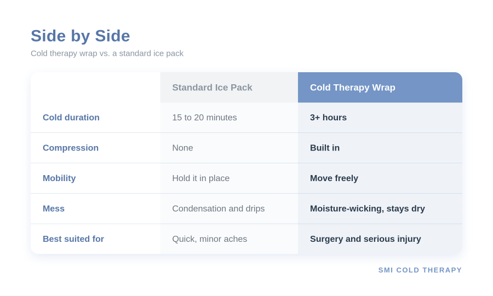
A bag of frozen peas is perfectly good for a stubbed toe, a mild sprain, or muscle soreness treatment after a hard workout. No need to overthink it. This is also where most ice therapy benefits live, simple cold for a simple problem.
A bigger injury raises the stakes. For orthopedic or spine surgery, or any injury you will be nursing for weeks, the advantages of cold compression therapy start to outweigh the low price of a basic pack. Longer cold, targeted delivery, and the freedom to move are exactly what serious injury recovery and athletic recovery call for, and exactly what a freezer bag cannot provide.
Not quite. Both use cold, but cold therapy systems are built to hold temperature far longer, often add compression, and many let you stay mobile. An ice pack delivers cold and little else.
No. They work fine for minor, short-term aches. They simply fall short when you need steady cold over hours or after surgery, which is where advanced cold therapy pulls ahead.
Cryotherapy is the medical umbrella term for cold-based treatment, and an ice pack is one basic form of it. Whole-body cryotherapy and cold compression wraps sit at the more advanced end of that same family.
Yes. Compression presses the cold toward the joint instead of leaving it on the surface, and it limits room for fluid to collect. That combination tends to cut swelling more effectively than cold on its own.
Ask your surgeon first. Many post-op protocols call for continuous, controlled cold that a basic pack cannot maintain, so follow the plan your care team gives you.
Standard packs come off every fifteen to twenty minutes to protect the skin. Systems that hold a safe, steady temperature can stay on longer, but always follow the application guidance and keep a barrier against bare skin when advised.
For a passing ache, the ice pack in your freezer is fine. For surgery or an injury you will be nursing for weeks, you want cold that lasts, compression that a basic pack cannot give, and the freedom to keep moving while you heal. That is the upgrade SMI Cold Therapy was built to deliver. See the wraps in action, then browse the full lineup and match one to your recovery.