When you are hurting, you want relief fast, and cold and heat are usually the first things within reach. Both can ease pain and support healing, but they work in opposite ways, and reaching for the wrong one at the wrong time can slow you down instead. The right choice at the right moment is one of the simplest ways to recover more comfortably, and it comes down to a single question about what your body needs.
Is the problem new or old? A fresh, swollen, painful injury wants cold. A stiff, nagging, tight ache wants heat. Nearly every decision follows from that one call.
The reason lives in how each affects blood flow. Cold tightens your blood vessels, which slows circulation to calm swelling and numb pain. Heat opens them, pulling blood in to relax muscle and loosen stiffness. Cold quiets an angry injury, and heat wakes up a sluggish one. Keep those two jobs straight, and everything else is just detail.
Cold therapy, sometimes called cryotherapy, does its best work in the first 48 to 72 hours after something goes wrong, while swelling and pain are still climbing. It slows the bleeding and fluid buildup under the skin, which is exactly what keeps an acute injury from ballooning.
Cold is the right call in situations like these.
One thing worth knowing is that how you apply cold matters as much as when. A loose ice pack sits on the surface and warms up within minutes. A wrap that adds pressure drives the cold deeper and squeezes out the space where fluid pools, which is why cold compression therapy tends to beat a bag of ice for real recovery.
Heat is the tool for aches that have overstayed their welcome. A stiff lower back, a neck that will not turn, an arthritic knee on a cold morning, muscles that tighten before you have even started moving, these all share a cause, and it is not swelling. They come from tension and sluggish circulation, and heat answers both by relaxing the muscle and drawing blood into the area. For an ongoing condition like arthritis, heat therapy can make a stiff joint feel usable again.
That same quality is why heat and a fresh injury are a bad match. The extra blood flow that soothes a tight muscle will only feed the swelling around a new sprain, so keep the heating pad in the drawer until the swelling is long gone and stiffness is all that is left.
A longer recovery often uses both, just not at the same time. Cold takes the early shift while swelling is the main problem, then heat steps in once the swelling fades and stiffness moves in. Athletes and physical therapy patients sometimes alternate the two on a set schedule. If you are rehabbing something specific, let your doctor or therapist set the timing instead of guessing at it.
Two mistakes cause most of the bad outcomes. The first is putting heat on a brand-new injury because it feels comforting, which invites more swelling into an area that is already flooding. The second is icing a chronically tight muscle that was begging for warmth, then wondering why it feels even more locked up afterward.
Past picking the right one, give your skin some respect. Keep sessions moderate, always put a layer between your skin and the source, and never apply cold or heat to an area that is numb or has lost sensation. When pain is severe, spreading, or simply not letting up, treat that as a cue to call your doctor rather than troubleshoot it yourself.
Cold and heat are not interchangeable, and the right pick keeps you from making a sore spot worse. For anything new, swollen, or fresh out of surgery, cold is the dependable choice, and steady, compressive cold beats a dripping ice pack every time.
See the cold therapy wraps built for post-surgical and orthopedic recovery and keep real cold on hand for the moments that call for it.
Use cold. For the first couple of days after a sprain, strain, or bruise, cold controls the swelling and numbs the pain. Save the heat for later, once the swelling has calmed and stiffness moves in.
That comes down to why the muscle hurts. If it is tight, sore, or overworked, heat usually feels better. If the pain comes with swelling or a fresh strain, cold is the safer call.
Yes, often one after the other, with cold first for the swelling and heat later for the stiffness. For a specific injury, follow the timing your doctor or therapist gives you.
Keep each session moderate and take breaks in between. Controlled cold systems that hold a steady temperature can stay on longer than a melting ice pack, but protect your skin either way and follow your provider’s guidance.
Cold is the answer, especially in the early days, when the whole job is controlling swelling and pain. Your surgeon will let you know if heat has a role further into recovery.
It often does. Warmth relaxes stiff, achy joints and makes them easier to move, though a hot and swollen arthritic flare may prefer cold. Read the joint and give it what it asks for that day.
Cold therapy can reduce opioid use after surgery, and a growing body of research supports the idea. It will not replace every prescription, but as one piece of a modern recovery plan, controlled cold can lower how many opioids a patient needs to stay comfortable. That is a meaningful shift at a time when the opioid crisis has surgical teams working to send patients home with fewer narcotics and less exposure to the risks that follow them.
For years, opioids were the default answer to surgical pain, prescribed in generous amounts that often ended up as leftovers in the medicine cabinet. Surgeons have since pulled back, combining several methods so no single one, opioids included, carries the whole burden. Cold therapy is one of the tools that made that shift practical, partly because a patient can keep using it at home without a prescription.
Pain after surgery comes largely from two sources, the surgical trauma itself and the swelling that follows. Cold works on both. It slows the nerve signals that carry pain, which dulls the sensation directly, and it narrows blood flow to limit the swelling that presses on tissue and keeps pain elevated. Lower baseline pain means fewer sharp spikes to chase, and fewer spikes means a patient reaches for medication less often. That is the straightforward logic behind cold therapy opioid reduction.
Cold therapy rarely works alone, and it is not designed to. Modern recovery leans on multimodal pain management, which combines several non-opioid tools so that opioids handle only what is left. A typical opioid-sparing plan pulls from several of these at once.
Each layer carries part of the load. Cold therapy is one of the easiest to keep up at home, which is a big reason it has earned a steady place in non opioid pain management after surgery.
The strongest support comes from orthopedics. In orthopedic surgery such as knee and shoulder procedures, studies have repeatedly tied post-operative cold therapy to lower pain scores and reduced opioid consumption in the early days of recovery. The size of that effect varies with the procedure and the way the cold is delivered, and cold is never the only factor at work.
Even with those caveats, the pattern holds consistently enough that many hospitals now build controlled cold into their standard recovery protocols. The clinical research points in one direction, which is that steady, well-applied cold helps patients lean on opioids less.
None of this is a reason to skip the pain medication your surgeon prescribes. Undertreated pain slows healing and makes everything harder. The point is to give cold therapy a real role so opioids can play a smaller one. Use it consistently in the first days when pain and swelling peak, keep it steady rather than occasional, and talk with your surgical team about an opioid-sparing plan that suits your procedure. A wrap that stays in the freezer cannot help you, so the habit you keep around it matters as much as the wrap itself.
Cold therapy is not a magic swap for pain medication, and no honest brand should sell it as one. What it does is real. Steady, well-applied cold lowers pain right at the source, which gives surgical teams and patients a safer way to keep opioids to a minimum.
The wraps that do this best hold their cold for hours and add the compression a basic pack cannot, so the relief stays steady through the days that matter most. Check out SMI’s cold therapy wraps to find the one built for your procedure, and talk with your care team about working cold therapy into your recovery plan.
No, and it is not meant to. Cold therapy reduces how much pain medication you need, but you should always follow the plan your surgeon gives you. Think of it as lightening the load on opioids, not removing the need for a pain plan.
Sometimes, for smaller procedures, though that is a decision for your care team. More often, cold therapy is one reason a patient needs fewer opioids or comes off them sooner, which is a real win on its own.
It slows the nerve signals that carry pain and limits the swelling that keeps pain elevated. Less swelling and dampened signaling add up to lower pain, which is why controlled cold supports non narcotic pain relief.
There is real evidence, strongest in orthopedic recovery, linking post-surgical cold therapy to lower opioid use. Results vary by study, so it is fair to call cold a proven helper rather than a cure.
Use it early and keep it consistent. Pain and swelling peak in the first two to three days after surgery, so that window is when steady cold does the most to keep you comfortable and reduce your reliance on medication.
Yes. Ask about opioid-sparing or multimodal pain management for your procedure. Most surgical teams welcome the conversation and can tell you how cold therapy fits your recovery.
Cryotherapy shows up in almost every recovery plan after surgery, usually explained as a simple way to reduce swelling. That is true, but it undersells what cold actually does. The relief a patient feels after an operation is the surface of a real physiological response, one that changes how tissue bleeds, how nerves fire, and how the body manages the trauma of an incision.
A closer look at the science explains why cold earns its place after surgery, and why the way it reaches the tissue matters as much as the temperature. The physiology is well understood, and it points to some practical conclusions about post-operative cryotherapy.
In a clinical setting, cryotherapy means the controlled application of cold to influence the body’s response to injury or surgery. It is the umbrella term that covers ice therapy, gel-based cold compression, and continuous cooling systems. The shared aim is not simply to feel cold. It is to lower tissue temperature enough to shift specific biological processes in a predictable, useful direction.
Surgery is a controlled injury, and the body answers it the way it answers any trauma, with bleeding, swelling, pain, and inflammation. Cold intervenes at several points in that cascade at once.
Cold triggers vasoconstriction, narrowing the vessels around the surgical site so less blood and fluid escape into the tissue. That fluid is what post-operative swelling and edema are made of, which is why cryotherapy for swelling works hardest in the first days after surgery, while bleeding and buildup peak.
Cooled tissue slows its metabolic rate, so nearby cells demand less oxygen. That restraint matters more than it sounds. After surgery, some cells around the wound sit on the edge of survival, and when their oxygen demand outruns the supply, the damage spreads outward as secondary injury. A lower temperature eases that demand and helps contain the total zone of harm.
The pain relief here is largely mechanical. Cold slows how fast nerves carry their signals and raises the threshold at which they fire, so fewer pain messages reach the brain at all. That drug-free analgesia is the core of cryotherapy pain management, and a big reason controlled cold is tied to lower opioid use after surgery.
Inflammation is not the enemy after surgery. It drives healing, so cold is meant to moderate it rather than switch it off, keeping a normal response from tipping into the swelling and pain that stall recovery. What reads as cryotherapy inflammation reduction is really inflammation control.
The clinical picture is strongest in orthopedics. Across studies of orthopedic surgery such as knee and shoulder procedures, post-operative cryotherapy is generally associated with lower reported pain, reduced use of pain medication, and less swelling in the early recovery window.
Evidence quality varies by procedure and study design, and cold therapy is one part of a broader recovery plan rather than a cure on its own. The direction of the clinical research is consistent enough, though, that continuous cold has become a standard part of post-surgical care in hundreds of hospitals.
The physiology only pays off when the cold is delivered well. A melting ice bag drops in temperature unevenly, warms within minutes, and tends to sit loosely on the surface. The tissue never reaches or holds the range where these mechanisms work best, which is the practical gap between clinical cryotherapy and ordinary ice therapy.
Controlled cold holds a steady, safe temperature for hours, and adding compression pushes the cold deeper toward the joint while limiting the space where fluid collects. How SMI applies that principle is the difference between cold that feels pleasant and cold that measurably supports recovery.
Cold is not a passive comfort measure after surgery. It acts on blood flow, metabolism, nerves, and inflammation at the same time, which is why controlled cryotherapy has earned a real place in post-operative care.
That science only reaches the patient when the cold is steady, lasting, and paired with compression. Find the wrap built for that kind of recovery and put the physiology to work where it counts.
Not quite. Icing is one basic form of cryotherapy. The term also covers gel-based cold compression and continuous cooling systems, which hold temperature longer and more evenly than a melting ice pack.
Cold does not heal tissue directly. What it does is control the swelling, pain, and secondary damage that slow recovery, which lets the body heal with less interference. It supports the process rather than replacing it.
Cold slows nerve conduction and raises the pain threshold, so fewer pain signals reach the brain. That built-in analgesia is part of why post-operative cryotherapy is linked to lower opioid use after surgery.
Used as directed, cold moderates inflammation rather than shutting it down. The aim is to keep a normal, helpful response from tipping into excessive swelling and pain. Follow your surgeon’s protocol on timing and duration.
No. Whole-body chambers expose the entire body to extreme cold for a short burst. Post-surgical cryotherapy applies targeted, sustained cold to one area to manage recovery, which is a different goal and a different method.
The evidence is strongest for orthopedic procedures like knee and shoulder surgery, where swelling and pain run high early on. Your surgical team can tell you how cold therapy fits your specific procedure.
Electric cooling machines have become a familiar sight in orthopedic recovery, humming at the bedside with a reservoir of ice water and a pad wrapped around the surgical site. They deliver cold, and they deliver it consistently. The question worth asking is whether all that hardware earns its place, or whether a simpler cold compression wrap reaches the same result with far less friction.
The answer affects cost, mobility, safety, and how reliably a patient keeps up with therapy once they leave the building. Both approaches cool tissue. How they get there, and what they ask of the patient and the facility, is where they part company.
A cooling machine works by circulating chilled water. A motorized pump draws from an ice-and-water reservoir and pushes it through a wrapped pad, running continuously as long as it stays plugged in and topped off with ice. The appeal is steady, uninterrupted cold.
The wrap takes a different route. Frozen gel bags sit inside a compression sleeve and hold a therapeutic temperature for hours with no pump, no power, and no water to manage. When a bag warms, you swap in a fresh one. The compression is built into the design rather than bolted on, so cold and pressure work together from the first minute.
Both methods cool the same tissue, so the decision comes down to the practical details around them. Five factors tend to separate a cooling machine from a compression wrap in everyday use.
A cooling machine is a capital purchase or an ongoing rental, and the price follows the patient home through daily use of ice and electricity. A cold therapy wrap carries none of that overhead. There is no unit to buy, service, or return, which changes the math for both a household and a facility stocking recovery after surgery across dozens of patients.
This is the sharpest split. A machine tethers the patient to a cord and a reservoir, which tends to keep them parked next to the unit. A wrap goes where the patient goes. Someone recovering from general surgery can walk to the kitchen, sleep on their side, or head to a follow-up appointment without unplugging anything. Therapy that fits into normal movement is therapy a patient actually keeps using, and compliance is where a lot of post-operative therapy quietly succeeds or fails.
A machine asks for a routine. Fill the reservoir, add ice, prime the line, monitor the water, and clean the whole system between patients. A wrap asks far less. Freeze the gel bags, slide them in, and put them on. Fewer moving parts mean fewer points where the therapy breaks down or gets skipped.
Any device that applies prolonged, uncontrolled cold carries a real risk of skin and nerve injury, which is why continuous cooling machines call for careful monitoring, barriers, and clear instructions. Gel-bag wraps warm gradually and tend to be worn in defined sessions, which narrows the window of risk. Skin protection and provider guidance still matter with either method, but the wrap leaves less room for the kind of set-it-and-forget-it mistake that leads to trouble.
For a hospital or surgery center, shared machines mean cleaning, turnover, and tracking units between rooms. Wraps sidestep most of that. They can be kept freezer-ready across a unit, assigned to a single patient, and standardized into a protocol without managing a fleet of motorized equipment. That consistency is part of what makes cold compression therapy easier to roll out at scale. Additionally, SMI provides all freezers at no extra charge and without minimum order requirements.
None of this erases the case for a cooling machine. Some surgeons build their protocols around continuous circulating cold, and certain patients or procedures genuinely benefit from it. A machine can be the right tool when a care team wants uninterrupted cooling under close supervision. The point is not that one option wins every time. It is that the default choice deserves a second look, because the simpler tool often matches the outcome at a fraction of the cost and hassle.
Are electric cooling machines more effective than cold therapy wraps?
Not automatically. Machines provide continuous cold, but a well-designed wrap delivers hours of therapeutic cold plus compression, and it does so without tethering the patient. For most recoveries, the measurable results land in the same range.
Often no. Many patients recover well with a cold compression wrap, which is simpler and less expensive. Your surgeon may prefer a specific method, so follow the protocol your care team sets.
Any continuous cold device can, if used improperly or without monitoring. Prolonged, uncontrolled cold is the risk factor, which is why these machines come with a barrier and supervision instructions. Session-based wraps reduce that exposure but still call for skin protection.
A machine runs as long as it has ice and power. A quality wrap, such as SMI Cold Therapy, holds cold for roughly three hours per set of gel bags, and swapping bags extends it without any of the refilling or plumbing.
A wrap usually is. It removes the purchase or rental of a unit along with the ongoing ice and electricity, which add up quickly across a full recovery or a busy facility.
In many cases, yes, and it travels far better. Confirm with your surgeon first, since some post-surgical recovery plans specify a particular device.
The gap between a cooling machine and a cold compression wrap comes down to what you are willing to manage for the cold you get. One brings a pump, a reservoir, and a cord. The other brings hours of cold and built-in compression that a patient can wear while they move.
For a closer look at how the wraps stack up against the equipment they replace, see the full comparison. If you are evaluating options for a practice or facility, connect with an SMI rep to talk through what fits your recovery protocols.
Most people use the words “ice pack” and “cold therapy” as if they describe the same thing, and for a minor bruise, the difference barely registers. After surgery or a serious injury, though, the distance between a freezer bag and a true cold therapy system turns out to matter quite a bit.
The two methods share a goal but go about it in very different ways. Knowing how they diverge, what each one handles well, and where one clearly beats the other makes it far easier to pick the option that actually fits your recovery.
Both approaches chase the same result. Lower the temperature of an injured area to ease pain, calm inflammation, and slow the swelling that follows trauma or surgery. The cold itself does real work, narrowing blood vessels and quieting the nerve signals that carry pain.
Where they part ways is in how they deliver that cold, how long they hold it, and what else they bring along with it.
A basic ice pack is cheap, easy to grab, and fine for short-term relief. Most households have one in the freezer. For a bumped knee or a sore shoulder after yard work, it gets the job done.
The trouble shows up the moment you need more than a few minutes of help. Its limits are practical.
For a quick ache, none of that is a dealbreaker. For post-surgery recovery that runs days or weeks, it adds up to a lot of melting, mopping, and sitting still.
Cold therapy treatment covers the more advanced end of the spectrum. Gel-bag systems, cold therapy machines, and cold compression therapy wraps are all designed to address the limitations of a plain ice pack.
The better systems hold their temperature for hours instead of minutes. Many add compression, which drives the cold deeper and limits the space where fluid can pool, speeding swelling reduction. And the well-designed ones let you move while you wear them, so recovery does not mean staying glued to the couch.
The fastest way to weigh the two is to line up the factors that actually affect recovery and see how each one holds up. A handful of categories separate a basic freezer bag from a purpose-built cold therapy wrap.
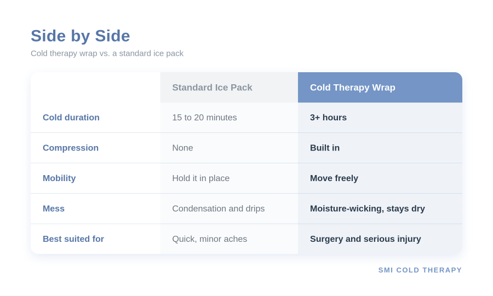
A bag of frozen peas is perfectly good for a stubbed toe, a mild sprain, or muscle soreness treatment after a hard workout. No need to overthink it. This is also where most ice therapy benefits live, simple cold for a simple problem.
A bigger injury raises the stakes. For orthopedic or spine surgery, or any injury you will be nursing for weeks, the advantages of cold compression therapy start to outweigh the low price of a basic pack. Longer cold, targeted delivery, and the freedom to move are exactly what serious injury recovery and athletic recovery call for, and exactly what a freezer bag cannot provide.
Not quite. Both use cold, but cold therapy systems are built to hold temperature far longer, often add compression, and many let you stay mobile. An ice pack delivers cold and little else.
No. They work fine for minor, short-term aches. They simply fall short when you need steady cold over hours or after surgery, which is where advanced cold therapy pulls ahead.
Cryotherapy is the medical umbrella term for cold-based treatment, and an ice pack is one basic form of it. Whole-body cryotherapy and cold compression wraps sit at the more advanced end of that same family.
Yes. Compression presses the cold toward the joint instead of leaving it on the surface, and it limits room for fluid to collect. That combination tends to cut swelling more effectively than cold on its own.
Ask your surgeon first. Many post-op protocols call for continuous, controlled cold that a basic pack cannot maintain, so follow the plan your care team gives you.
Standard packs come off every fifteen to twenty minutes to protect the skin. Systems that hold a safe, steady temperature can stay on longer, but always follow the application guidance and keep a barrier against bare skin when advised.
For a passing ache, the ice pack in your freezer is fine. For surgery or an injury you will be nursing for weeks, you want cold that lasts, compression that a basic pack cannot give, and the freedom to keep moving while you heal. That is the upgrade SMI Cold Therapy was built to deliver. See the wraps in action, then browse the full lineup and match one to your recovery.
People have reached for ice after an injury for as long as there has been ice to reach for. The cold numbs, the swelling drops, and the ache eases off. What most people never learn is the mechanism behind that relief, or why some forms of cold therapy work far better than a bag of frozen peas.
It’s helpful to know what cold therapy is, what happens inside your body when you apply it, and how the method you choose shapes your recovery.
Cold therapy is the controlled use of cold to treat pain, swelling, and inflammation. You will also see it called cryotherapy, the medical umbrella term for any treatment that uses low temperatures for a therapeutic result. Ice therapy, gel packs, cold compression therapy, and clinical cryotherapy treatment all sit under that same heading.
The end goal is to lower the temperature of an injured or post-surgical area enough to calm the tissue, slow the processes that drive pain, and stop swelling from getting out of hand.
Here is where cold therapy earns its reputation. The relief is not just a distraction from pain. Cold sets off a chain of physical responses that change how injured tissue behaves.
When cold reaches the skin and the tissue beneath it, blood vessels narrow. This is called vasoconstriction, and it pulls blood flow away from the area. Less blood flow means less fluid pooling around the injury, which is the root of visible swelling and edema.
From there, three things happen:
Together, that adds up to real inflammation reduction and swelling reduction, not a temporary mask over the discomfort. It is also why cold treatment for inflammation remains one of the first tools clinicians reach for.
Cold on its own helps. Cold, paired with compression, does more.
Compression drives the cold deeper toward the joint or surgical site instead of letting it sit on the surface. It also physically limits the space where fluid can collect, which speeds swelling reduction. This is the idea behind cold compression therapy, and it explains why a snug, well-designed wrap outperforms a loose ice pack resting on top of a bandage.
Fit matters, too. A wrap that holds its position lets someone stay mobile while still getting continuous cold, rather than lying still and tethered to a machine.
Cold therapy is one of the most widely used recovery tools in both medicine and sport. A few of the most common settings:
Post-surgical recovery is the big one. After orthopedic, spine, or general surgery, cold therapy helps manage post-op pain and edema, and clinical research has linked it to a reduced need for opioids during recovery.
Athletes and active people rely on it for muscle recovery, sports injury recovery, and post-workout recovery. A rolled ankle, a strained hamstring, or a brutal training session all respond well to early cold therapy.
Soft tissue injury treatment rounds out the list. Sprains, strains, deep bruises, and the swelling that tags along with them are textbook cases for therapeutic cold treatment and a steady part of injury rehabilitation.
Most cold therapy works best in sessions rather than being left on indefinitely. Traditional ice packs lose their chill fast and need swapping every 15 to 20 minutes. Cold therapy systems that hold temperature for hours change that math, allowing longer, steadier application without the constant resets. A cold therapy machine or gel-bag wrap that stays cold for 3+ hours means far less hands-on fuss, and the steps to apply one take only a minute or two.
Whatever the method, the rule holds. Protect the skin, follow your provider’s guidance, and avoid resting a cold source directly against bare skin for long stretches.
More or less. Cryotherapy is the broad medical term for cold-based treatment, and cold therapy is the everyday name for it. A whole-body cryotherapy chamber and a cold compression wrap belong to the same family.
A standard ice pack delivers cold and nothing else, and it warms up quickly. A cold therapy machine or compression wrap delivers steadier cold, often with compression built in, which improves how deeply and how long the treatment works.
Both. The numbing is real, but so is the inflammation reduction. By narrowing blood vessels and slowing cellular activity, cold therapy limits the fluid buildup and chemical activity that cause swelling in the first place.
Cold therapy does its best work in the early window, when swelling and pain peak. For surgical recovery, your surgeon or care team will give you a specific protocol. For an acute injury, sooner is generally better, within reason.
Yes. Overdoing it can irritate the skin and nerves. Stick to recommended session lengths, keep a barrier between the cold source and bare skin when advised, and watch how the skin looks and feels.
Not always. People with certain circulatory conditions or cold sensitivity should check with a doctor first. A provider can confirm whether cold therapy fits your situation before you start.
The science makes the difference between treatments easy to see. Cold alone helps. Cold, paired with compression, held at a steady temperature for hours, and built to keep patients moving, is what turns a basic remedy into a recovery tool clinicians trust.
Understanding the why is the easy part. The harder question is whether it works, and the data answers that. SMI wraps are used in more than 600 hospitals and have been shown in clinical studies to cut post-op pain and reduce opioid use. See the science behind SMI or shop the wraps when you are ready.